Giuliana Bueno
Marketing Manager
Why senior-led studios are the strategic choice for scaling complex digital products and reducing development risk.
Most product failures stem from a disconnect between high-level strategy and technical execution. For founders and CTOs, finding a partner that bridges this gap is the difference between a scalable asset and a costly rewrite.
"Choosing a digital product design agency in Europe allows tech leaders to access senior-level talent that bridges the gap between strategy and engineering. By focusing on human-centric solutions and rigorous product discovery, these studios reduce development risk and build scalable products for the global market."
The landscape of digital product development has shifted from a race for features to a battle for retention and scalability. For tech leaders at startups and enterprises alike, the challenge is no longer just 'building an app' but navigating the complexity of legacy systems, user expectations, and rapid market shifts. Choosing a digital product design agency in Europe is no longer just a cost-saving measure; it is a strategic move to access a mature ecosystem of senior talent that prioritizes the 'why' over the 'what.' This article explores the nuances of the European agency market and how a senior-led, human-centric approach mitigates the inherent risks of modern product development.
Europe has solidified its position as a global powerhouse for digital product design. According to the State of European Tech 2025 report by Atomico, the region continues to produce high-caliber engineering and design talent that rivals Silicon Valley, but with a distinct focus on sustainable growth and human-centricity. For US-based companies, the appeal lies in the maturity of the ecosystem. Countries like **Portugal, Poland, and Germany** have become hubs where design isn't just about aesthetics; it is a rigorous discipline rooted in problem-solving.
The shift toward European studios is driven by a need for senior-level expertise. In a market where junior-heavy agencies often lead to technical debt, European studios like Untile leverage decades of experience to ensure that the architecture built today can withstand the demands of tomorrow. This isn't just about outsourcing tasks. It is about a peer-to-peer partnership where the agency acts as an extension of the internal team, challenging assumptions and refining the product vision.
A common mistake many CTOs make is hiring a 'feature factory'—an agency that executes a backlog without questioning the underlying business logic. This approach almost always leads to a product that is technically functional but commercially irrelevant. A true digital product design agency in Europe operates differently. They begin with Product Discovery and Research to validate the 'why' before a single line of code is written.
Consider a scenario where a scaleup needs to migrate a legacy system to a modern microservices architecture. A junior team might jump straight into coding the new interface. A senior-led studio will first analyze the data flow, user friction points, and long-term business goals. They might find that the problem isn't the interface at all, but a bottleneck in the backend logic. By identifying this early, they save the client months of wasted development time and hundreds of thousands of dollars in potential rework.
This pragmatic approach is what defines the expert-to-peer relationship. It requires the confidence to say 'no' to a client's request if it doesn't align with the product's success. This level of honesty is rare but essential for reducing development risk in complex environments.
While cost is always a factor, the conversation has moved toward Value-per-Dollar. In 2025, data from industry benchmarks showed that while hourly rates in Western Europe and the US are converging for top-tier talent, the efficiency of senior European teams remains a significant advantage. A senior engineer in Portugal might cost 30% less than their counterpart in San Francisco, but they often bring a broader range of full-stack experience and a more stable tenure within their agency.
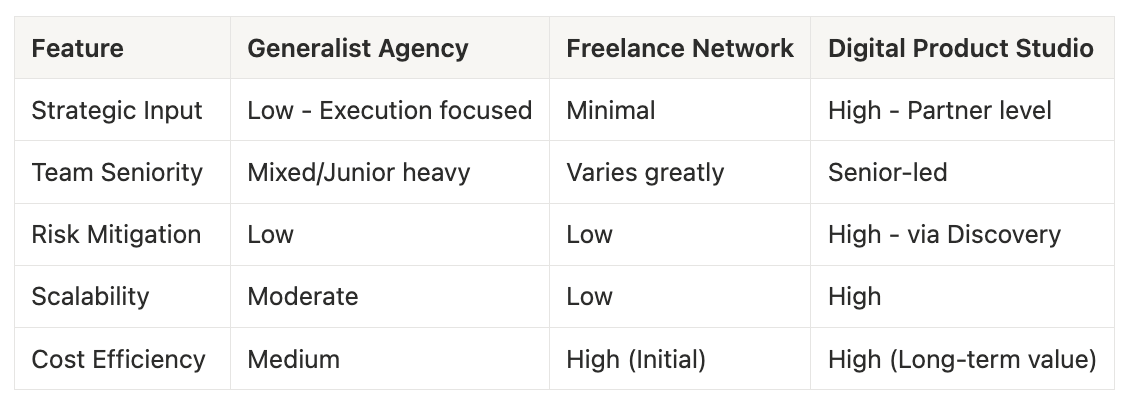
The following table illustrates the differences between engagement models often found when looking for a digital product design agency in Europe:
The term 'human-centric' is often dismissed as marketing jargon, but in the context of a high-performing digital product studio, it is a technical requirement. It means designing systems that respect the user's cognitive load and engineering backends that are resilient to human error. This synergy between UX/UI Design and Front-end/Back-end Engineering is where the most successful products are born.
At Untile, the philosophy is that design and engineering are two sides of the same coin. An interaction designer might propose a complex animation that delights the user, but a senior engineer will evaluate its impact on mobile performance and battery life. This constant feedback loop ensures that the final product is not only beautiful but also performant and scalable. According to a 2025 Forrester report, companies that invest in high-quality UX see a conversion rate increase of up to 400%, but only if the underlying technology supports that experience without lag or crashes.
The most expensive mistake a tech leader can make is building the wrong product perfectly. Product Discovery is the insurance policy against this risk. A European agency with a senior-led approach will spend significant time in the discovery phase, using frameworks like Design Sprints or Jobs-to-be-Done to uncover the real needs of the target audience.
This phase isn't just about user interviews. It involves technical feasibility studies, market analysis, and risk assessment. For a CTO, this provides a clear roadmap and a validated backlog, which significantly reduces the 'unknown unknowns' that typically plague mid-development cycles. By the time the MVP development begins, the team has a high degree of confidence in the product-market fit and the technical path forward.
For US-based companies, the time zone difference with Europe is often viewed as a hurdle, but it can be leveraged as a 'follow-the-sun' advantage. A 5 to 8-hour overlap allows for synchronous strategic meetings in the morning (US time) while the European team handles the heavy lifting during the US night. This creates a continuous development cycle that can actually accelerate timelines.
The key to making this work is asynchronous communication and a culture of documentation. Senior-led studios excel at this because they understand that clarity is the antidote to complexity. They use tools like Slack, Notion, and Jira not just for tracking tasks, but for capturing the 'intent' behind every decision. This ensures that when the US team wakes up, they have a clear picture of the progress made and the rationale behind it.
Comparison of Engagement Models
What is the difference between a design agency and a product studio?
A design agency often focuses primarily on the visual and user experience aspects of a project. A digital product studio, like Untile, integrates strategy, design, and full-stack engineering to build and scale end-to-end products. The studio approach is more holistic and focused on long-term business outcomes.
How long does a typical Product Discovery phase take?
A thorough discovery phase usually lasts between 2 to 6 weeks. This depends on the complexity of the product and the amount of existing research. The goal is to emerge with a validated MVP definition, a technical roadmap, and a clear understanding of user needs.
How do you manage communication across different time zones?
We utilize a blend of synchronous meetings during overlap hours and robust asynchronous documentation. This ensures that all stakeholders are aligned on goals and progress, regardless of their physical location. We prioritize transparency and use tools that provide real-time visibility into the development process.
Do you work with existing internal tech teams?
Absolutely. We often act as a senior-level extension of internal teams, providing specialized expertise in areas like UX research, complex backend architecture, or mobile development. Our goal is to augment your capabilities and help reduce development risk.
What technologies do European agencies typically specialize in?
Most top-tier European studios are tech-agnostic but lean toward modern, scalable stacks. Common specializations include React, Vue.js, Node.js, Python, and Go, as well as native and hybrid mobile frameworks like Flutter or React Native.
How does human-centric design impact ROI?
Human-centric design reduces user churn and support costs by making the product intuitive. By solving the right problems for the user from the start, you avoid the high costs of pivoting or rebuilding features that don't resonate with the market.
What is the average cost of a digital product design agency in Europe?
In 2025, rates for senior-led European agencies typically range from $75 to $150 per hour, depending on the region and specialization. This offers a significant value compared to US-based agencies where similar expertise often starts at $200+ per hour.
How do I choose the right design agency in Europe?
Look for agencies with a proven track record of 10+ years, a strong focus on both design and engineering, and a transparent discovery process. Evaluate their ability to act as a strategic partner rather than just a vendor.
Why is Portugal a hub for digital product design?
Portugal offers a unique combination of high-quality engineering education, strong English proficiency, and a growing ecosystem of tech startups, making it a top destination for senior-level digital product studios.
Can a European agency handle US compliance like HIPAA or SOC2?
Yes, many senior European agencies are well-versed in international security standards and regularly work with US clients in regulated industries like Fintech and Healthtech, ensuring full compliance with local laws.