Ricardo Correia
Co-founder & Head of Business
A strategic guide for product leaders on leveraging Portuguese engineering talent to build scalable digital products.
Building a mobile product requires more than just writing code. It demands a partner who understands the intersection of business strategy, human-centric design, and high-stakes engineering.
"Portugal is a top-tier hub for mobile development, offering senior engineering talent and a product-first mindset. By choosing a senior-led studio that integrates strategy, design, and engineering, tech leaders can build scalable, human-centric products while significantly reducing development risk."
The landscape of mobile development has shifted. In 2026, the challenge for CTOs and founders is no longer just finding someone to build an app, but finding a partner capable of navigating the complexity of modern tech stacks and user expectations. Portugal has positioned itself at the center of this shift. With a tech ecosystem that has matured significantly over the last decade, the country offers a unique blend of technical rigor and creative problem-solving. This article examines why senior-led Portuguese studios are becoming the preferred choice for scaleups and enterprises looking to reduce development risk while delivering world-class digital experiences.
Portugal is no longer an emerging market in the tech world: it is a consolidated hub of engineering excellence. According to the 2025 Digital Economy Report by AICEP, the Portuguese tech sector now accounts for over 10 percent of the national GDP, driven by a surge in high-value software exports. For a product leader in the United States or Northern Europe, this translates to a talent pool that is both highly skilled and culturally aligned with global business standards.
One of the most significant factors is the quality of technical education. Institutions like Instituto Superior Técnico in Lisbon and the University of Porto consistently rank among the top engineering schools in Europe. These programs emphasize foundational computer science principles, which means developers in Portugal tend to be engineers first and coders second. They understand the 'why' behind the architecture, not just the 'how' of the syntax.
We have seen that the most successful partnerships are built on more than just proximity. They are built on a shared mindset. Portuguese engineers are known for their pragmatism and adaptability, traits that are essential when navigating the pivot-heavy environment of a growing startup or a complex corporate digital transformation.
There is a fundamental difference between a traditional outsourcing agency and a digital product studio. Traditional agencies often operate on a 'feature factory' model, where they execute a list of requirements without questioning the underlying business value. In contrast, a senior-led studio in Portugal acts as a strategic partner. This distinction is vital for tech founders who need to reduce development risk.
A senior-led approach means that the people in the room during your discovery sessions are the same people who will oversee the architecture of your application. They bring 15 years of experience in the trenches to the table, allowing them to anticipate bottlenecks before they occur. This level of seniority is rare in larger, volume-driven outsourcing firms where junior developers often handle the bulk of the work under minimal supervision.
Consider the scenario of a scaleup looking to migrate from a monolithic architecture to a microservices-based mobile backend. A junior team might follow the instructions to the letter, but a senior-led team will challenge the necessity of the migration if the current user load doesn't justify the added complexity. They focus on Product Strategy and Management as much as they do on engineering. This ensures that every line of code serves a specific business objective, whether that is increasing user retention or reducing operational overhead.
Common mistakes we see in mobile development often stem from a lack of early-stage research. A senior partner will insist on a robust Product Discovery and Research phase. This involves validating assumptions through user interviews and prototyping before a single line of production code is written. By investing in discovery, you avoid the 'sunk cost' of building features that users don't actually need.
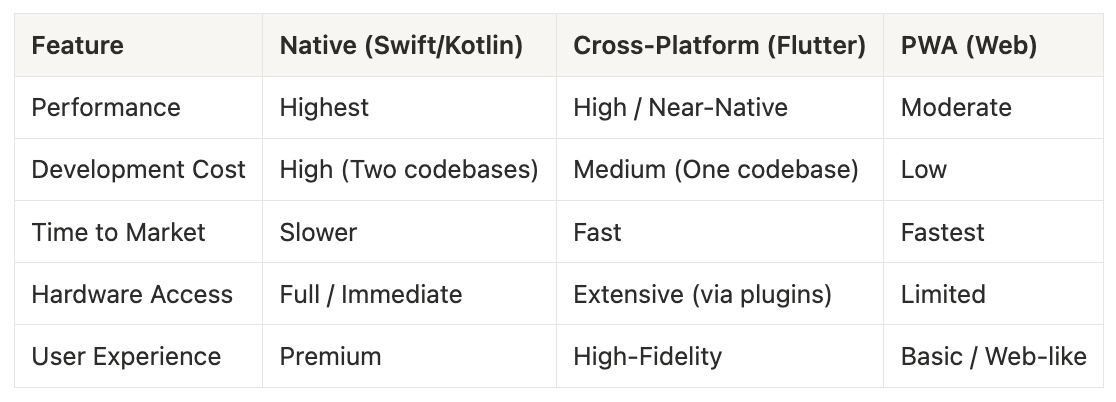
The debate between native and cross-platform development has evolved. In 2026, the choice is no longer about performance alone, but about speed to market, maintenance costs, and the specific needs of the user experience. A sophisticated mobile app development company in Portugal will help you navigate this decision based on your product's roadmap rather than a preference for a specific tool.
Native Development (Swift and Kotlin) remains the gold standard for applications that require deep integration with device hardware, such as advanced AR features, complex background processing, or high-performance gaming. If your product relies on the absolute latest OS features the moment they are released, native is the path. However, it requires maintaining two separate codebases, which can double the long-term maintenance effort.
Cross-Platform Frameworks (Flutter and React Native) have reached a level of maturity where the performance gap is negligible for 95 percent of business applications. Flutter, in particular, has seen massive adoption in the Portuguese tech scene due to its excellent developer experience and high-fidelity UI capabilities. It allows for a single codebase to power both iOS and Android apps, significantly reducing the time to market for an MVP (Minimum Viable Product).
Our engineering philosophy centers on choosing the right tool for the job. We don't believe in a one-size-fits-all approach. Whether it is a hybrid solution or a fully native build, the goal is always to create a scalable digital product that can grow alongside your user base without requiring a complete rewrite every two years.
Engineering excellence is only half the battle. A mobile app that is technically perfect but difficult to use will fail. This is where UX/UI Design and Interaction Design become the differentiators. In the Portuguese design community, there is a strong emphasis on human-centric solutions. This means designing for the person behind the screen, understanding their context, their frustrations, and their goals.
Human-centric design starts with empathy. It involves mapping out user journeys that feel intuitive and frictionless. For example, in a fintech application, the 'human-centric' approach isn't just about making the dashboard look clean: it is about ensuring that a user can complete a high-stakes transaction with total confidence and zero ambiguity. This requires a deep understanding of cognitive load and visual hierarchy.
Interaction design is another critical layer. It is the 'feel' of the app: the subtle haptic feedback when a button is pressed, the smooth transition between screens, and the way the app responds to gestures. These details might seem minor, but they are what separate a 'good' app from a 'world-class' product. According to a 2025 report by Forrester, companies that prioritize superior UX design see a conversion rate increase of up to 400 percent.
At Untile, we integrate design and engineering from day one. Designers don't just hand over a Figma file and walk away. They work alongside engineers to ensure that the vision is technically feasible and that the final product matches the design intent perfectly. This collaborative loop reduces friction and ensures that the Interaction Design is implemented with the precision it deserves.
Choosing a partner is a high-stakes decision. To mitigate risk, tech leaders must look beyond the portfolio and evaluate the partner's processes and culture. A common mistake is focusing solely on the hourly rate. While Portugal offers competitive pricing, the real value lies in the efficiency and quality of the output. A senior team charging $80 per hour will often deliver a better product faster than a junior team charging $40 per hour who requires constant hand-holding and rework.
When vetting a mobile app development company in Portugal, ask about their approach to MVP Definition and Development. A good partner will help you trim the fat from your initial idea, focusing on the core value proposition that will allow you to test the market quickly. They should be comfortable saying 'no' to features that add complexity without adding value.
Transparency is another non-negotiable. You should have direct access to the engineers and designers working on your project. Look for partners who use agile methodologies and provide regular, meaningful updates. This includes not just what was built, but what challenges were encountered and how they were solved. This level of honesty is the foundation of a peer-to-peer relationship.
Finally, consider the long-term. A mobile app is never 'finished.' It requires ongoing maintenance, security updates, and feature iterations. You need a partner who is interested in a long-term relationship, not just a one-off project. Ask about their post-launch support and how they handle scaling as the user base grows. A partner who thinks about Front-end and Back-end Engineering with scalability in mind from the start will save you significant technical debt in the future.
Mobile Development Approaches in 2026
What is the average timeline for an MVP build in Portugal?
A typical MVP build for a mobile application takes between 3 to 5 months. This includes phases for product discovery, UX/UI design, development, and rigorous testing. The timeline can vary based on the complexity of the core features and the integrations required.
How do Portuguese companies handle intellectual property (IP)?
As part of the European Union, Portugal follows strict IP laws and GDPR regulations. Reputable development studios include clear IP transfer clauses in their contracts, ensuring that the client owns 100% of the code and design assets upon payment.
Can a Portuguese team work with my existing in-house developers?
Yes, many senior-led studios in Portugal are experienced in 'team augmentation' or collaborative models. They can integrate into your existing workflows, using tools like Slack, Jira, and GitHub to act as an extension of your internal team.
What tech stacks are most common in Portugal for mobile development?
The Portuguese tech scene is diverse. For mobile, Flutter and React Native are highly popular for cross-platform needs. For native builds, Swift (iOS) and Kotlin (Android) are standard. Backend systems are often built using Node.js, Python, or Elixir for high-concurrency needs.
How does the 'Product Studio' model differ from traditional outsourcing?
A product studio focuses on the 'why' and the 'what' before the 'how.' They provide strategic guidance, product management, and user research, whereas traditional outsourcing often focuses purely on executing a pre-defined set of technical tasks without questioning their business impact.
Why is Portugal a good place for mobile app development?
Portugal offers a highly skilled pool of senior engineers, excellent English proficiency, and a stable EU business environment. Its time zone alignment with the UK and significant overlap with the US make it an ideal hub for collaborative, high-quality software development.
How much does it cost to develop a mobile app in Portugal?
While costs vary based on complexity, senior-led development in Portugal typically ranges from $60 to $100 per hour. This provides a significant cost-to-quality advantage compared to similar expertise in the US or UK, where rates often exceed $150 per hour.
Is it better to build a native or cross-platform mobile app?
The choice depends on your specific needs. Native is best for high-performance, hardware-intensive apps. Cross-platform (Flutter/React Native) is ideal for most business applications, offering faster time-to-market and lower maintenance costs with a single codebase.
What should I look for in a Portuguese app development partner?
Look for a senior-led team that emphasizes product discovery, has a strong portfolio of scalable products, and demonstrates a human-centric design philosophy. Transparency, direct communication with engineers, and a focus on business value are key indicators of a good partner.