Nelson Alves
Head of Design
Why senior-led design is the ultimate risk mitigation strategy for tech founders
Most startups fail not because of bad code, but because they build products nobody wants to use. Investing in senior-level UI UX design early isn't a luxury; it's how you ensure your product survives the transition from MVP to market leader.
"UI UX design is a strategic investment that reduces development risk and accelerates growth for startups. By focusing on a Minimum Lovable Product and implementing a robust design system, founders can build scalable, human-centric products that win in the 2026 market."
The current venture landscape has shifted. In 2026, investors are no longer funding 'growth at all costs' but are instead looking for capital-efficient products with high retention. For tech founders and CTOs, this means the margin for error in product development has vanished. You cannot afford to spend six months building a feature set that users find confusing or irrelevant. UI UX design is often misunderstood as the 'visual layer' applied at the end of a sprint. In reality, it is a rigorous engineering discipline focused on reducing friction and maximizing value. At Untile, we have spent 15 years in the trenches helping startups navigate this complexity by treating design as a core business strategy rather than an aesthetic afterthought.
When founders think about ROI, they often look at conversion rates or churn. While those are critical metrics, the most immediate return on investment for high-quality UI UX design is the reduction of development waste. According to a 2025 report by the Nielsen Norman Group, fixing a software error after release can cost up to 100 times more than fixing it during the design phase. By the time a developer writes a single line of code, the product's logic should have already been stress-tested through interactive prototypes.
Senior-led design teams focus on the 'why' before the 'how.' This pragmatic approach prevents the common startup trap of 'feature creep,' where products become bloated with unnecessary tools that confuse the user. A streamlined user experience ensures that your engineering team is only building what is strictly necessary for the user to achieve their goal. This efficiency is what separates scaleups from startups that burn through their seed funding without gaining traction.
A 2025 McKinsey study highlighted that companies in the top quartile of design performance outperformed industry benchmarks by as much as two to one in terms of revenue growth. For a startup, this isn't just about making things look good; it is about building a foundation that can support rapid scaling without collapsing under the weight of technical and design debt.
The traditional Minimum Viable Product (MVP) model often leads founders to release products that are functional but frustrating. In a saturated market, 'functional' is the bare minimum. To win users in 2026, you need a Minimum Lovable Product (MLP). This approach prioritizes the emotional connection and ease of use that keeps users coming back. It is the difference between a tool someone uses because they have to and a product they recommend to their peers.
Creating an MLP requires a deep understanding of user psychology. We use Product Discovery and Research to identify the 'aha moment' for your users. This is the specific point where the user realizes the value of your product. If your UI UX design doesn't lead the user to that moment within the first 60 seconds, you have likely lost them forever. According to data from the Baymard Institute, even minor friction in the onboarding or checkout process can lead to abandonment rates as high as 70 percent.
Consider the following scenario: A fintech startup builds a powerful backend for cross-border payments but neglects the mobile interface. Users find the KYC (Know Your Customer) process cumbersome and the dashboard confusing. Despite having the best exchange rates in the market, the startup fails because the user experience feels untrustworthy. A human-centric design approach would have prioritized trust-building elements, clear progress indicators, and simplified data entry, turning a complex regulatory requirement into a seamless user journey.

Even the most brilliant CTOs can fall into design traps that jeopardize their product's success. One of the most frequent mistakes is designing for themselves rather than the actual user. Founders are power users by nature; they understand the logic of their product intimately. However, your end-user likely lacks that context. If your interface requires a manual to understand, the design has failed.
Another common pitfall is the over-reliance on trends. While it might be tempting to adopt the latest 'glassmorphism' or 'neobrutalist' aesthetic, these trends often age poorly and can compromise accessibility. A senior-led design team focuses on timeless principles of hierarchy, contrast, and navigation. We prioritize Interaction Design that feels natural and predictable, ensuring that the product remains usable for a diverse audience, including those with accessibility needs.
Finally, many startups neglect Design Systems until it is too late. A design system is a living library of reusable components, patterns, and documentation. Without one, your product will inevitably become a patchwork of inconsistent buttons, fonts, and layouts as you scale. This inconsistency doesn't just look unprofessional; it creates cognitive load for the user and massive technical debt for the developers. Implementing a design system during the early stages of a scaleup is one of the most effective ways to ensure long-term product health.
As a startup moves from Seed to Series B, the role of UI UX design evolves from survival to optimization. At the Seed stage, the focus is on validation and speed. By Series A, the focus shifts to Product Strategy and Management, ensuring that new features align with the core value proposition. By Series B, the product must be a well-oiled machine capable of supporting hundreds of thousands of users without friction.
This transition requires a partner who understands the nuances of scaling. It is no longer just about the interface; it is about the Product Ecosystem. This includes how the product handles edge cases, how it integrates with third-party tools, and how it maintains performance under load. At Untile, we combine engineering rigor with design empathy to build products that don't just look good on a pitch deck but perform in the real world.
For CTOs, the challenge is often managing the tension between speed and quality. A senior design partner acts as a bridge, ensuring that the product roadmap is realistic and that the design vision is technically feasible. This collaborative approach reduces the 'us vs. them' mentality that often exists between design and engineering teams, leading to a more cohesive and successful product.
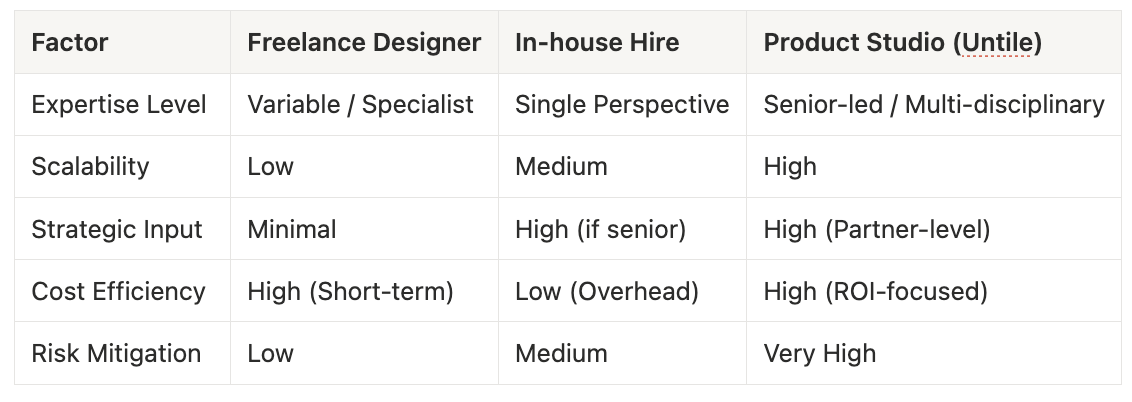
The Decision Framework for Scaling Design:
How do you know if your investment in UI UX design is actually working? For founders and product leaders, the answer lies in the data. While 'beauty' is subjective, 'usability' is measurable. We recommend tracking a specific set of Key Performance Indicators (KPIs) that directly correlate with design quality.
Task Success Rate (TSR) is perhaps the most critical metric. It measures the percentage of users who can successfully complete a core task, such as signing up or making a purchase. If your TSR is low, your UX is failing. Another vital metric is Time on Task. In most cases, a shorter time indicates a more efficient and intuitive design. However, for content-heavy products, you might look for high Engagement Rates instead.
Beyond these, consider the System Usability Scale (SUS), a standardized questionnaire that provides a quick and reliable way to measure the perceived usability of your product. By benchmarking your SUS score against industry standards, you can get a clear picture of where your product stands. According to a 2025 industry analysis, companies that actively track and improve these metrics see a 35 percent higher customer lifetime value (CLV) compared to those that do not.
Ultimately, the goal of UI UX design for startups is to create a product that is so intuitive it becomes invisible. When the design is right, the user doesn't notice the interface; they only notice the value they are receiving. That is the hallmark of a world-class digital product.
Design Resource Comparison for Startups
Why is human-centric design important for tech startups?
Human-centric design ensures that the product solves real problems for real people. For tech startups, this prevents the common mistake of building 'technology in search of a problem.' It grounds the development process in user empathy, leading to higher adoption and retention rates.
How does UI UX design impact product-market fit?
Product-market fit occurs when a product satisfies a strong market demand. UI UX design facilitates this by removing the barriers between the user and the product's value. A product with poor UX will struggle to achieve fit even if the underlying technology is revolutionary.
What are the benefits of outsourcing design to a digital product studio?
Outsourcing to a studio like Untile provides access to senior-level expertise across strategy, design, and engineering without the overhead of hiring a full-time team. Studios bring 'in the trenches' experience from multiple industries, helping startups avoid common pitfalls and accelerate their time-to-market.
How do you handle design debt in a fast-growing startup?
Design debt is managed by implementing a design system early and conducting regular UX audits. It requires a pragmatic approach where small, incremental improvements are made alongside new feature development to ensure the product doesn't become fragmented.
What role does user research play in the design process?
User research is the foundation of the design process. It involves interviews, surveys, and usability testing to gather data on user behavior and preferences. This data-driven approach eliminates guesswork and ensures that the design team is solving the right problems.
How much should a startup spend on UI UX design?
Startups typically allocate 10% to 20% of their total development budget to UI UX design. For early-stage companies, investing in a senior-led design phase during product discovery can save significant costs by preventing the development of features that don't meet user needs.
What is the difference between UI and UX for startups?
UX (User Experience) focuses on the overall feel of the experience and how easily a user can achieve their goals. UI (User Interface) focuses on the visual touchpoints, such as buttons, icons, and spacing. Both are critical; UX ensures the product works, while UI ensures it is professional and trustworthy.
When should a startup hire a UI UX designer?
A startup should involve a designer as early as the ideation phase. Having a designer during product discovery ensures that the product's value proposition is translated into a usable format before any engineering resources are committed.
Can a startup use a UI kit instead of custom design?
UI kits are useful for rapid prototyping or internal tools, but for a core product, custom design is necessary to differentiate the brand and solve specific user pain points that generic kits cannot address.